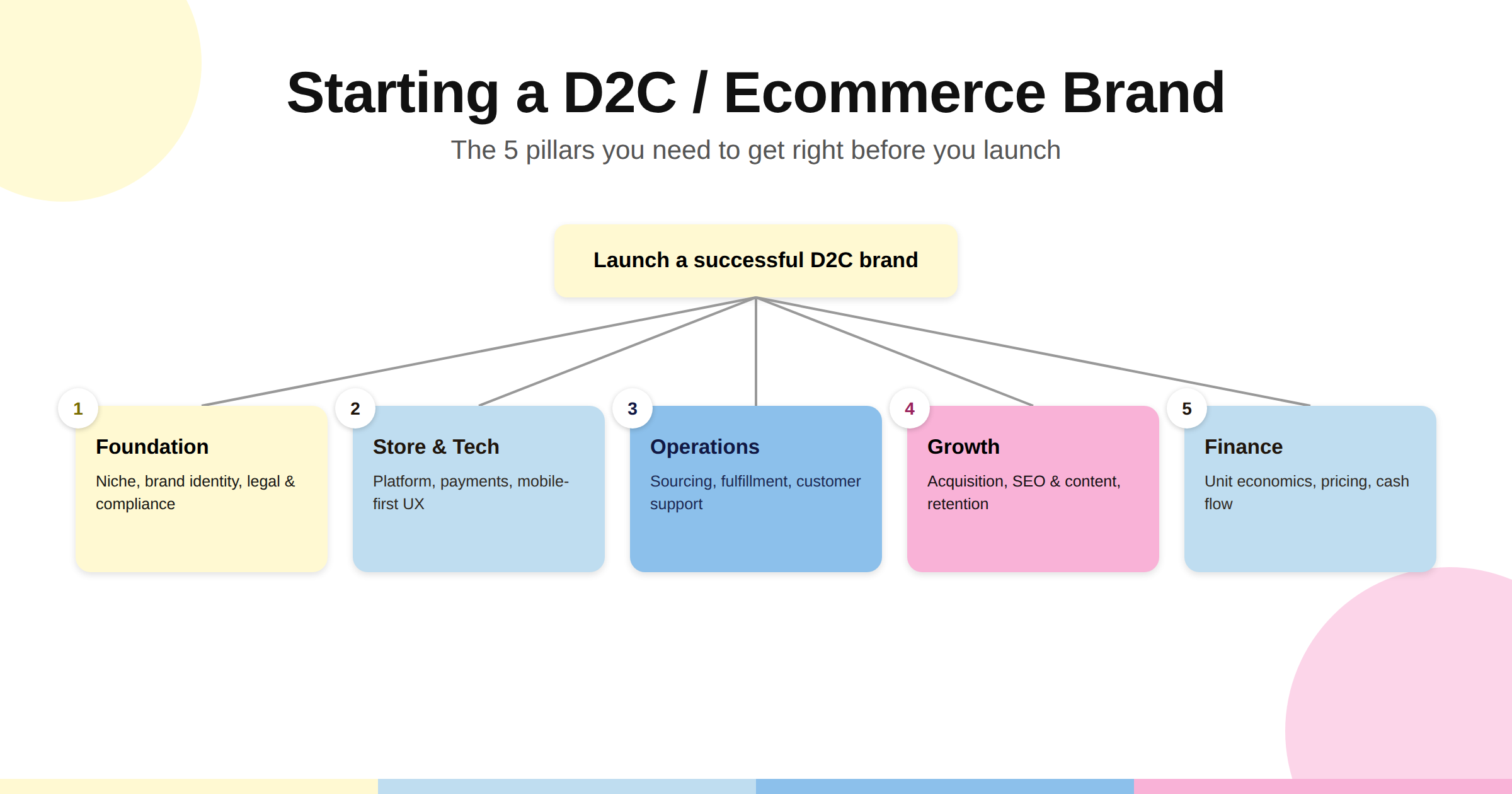
Starting a D2C or Ecommerce Brand: A Complete Guide to What Actually Matters
Every year, thousands of new direct-to-consumer brands launch, and a large share of them quietly disappear within eighteen months. It’s rarely because the founders lacked hustle. It’s usually because one or two foundational pieces were missing or under-built — a niche that was never really validated, unit economics that never worked, or a fulfillment process that quietly bled customer trust one late delivery at a time.
This guide walks through the five pillars that determine whether a new ecommerce brand survives its first two years: foundation, store and technology, operations, growth, and finance. None of these are optional, and none of them can fully compensate for a weakness in another. A brilliant brand with broken fulfillment fails. A well-run operation with no clear positioning fails just as fast, just more slowly and painfully.
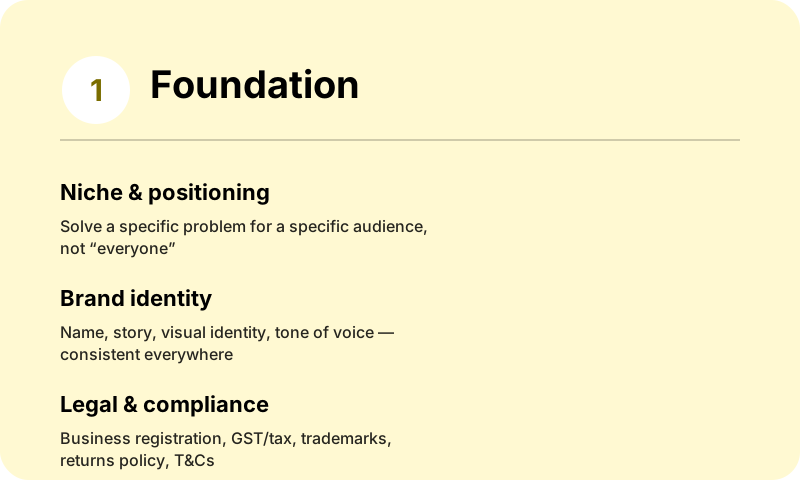
1. Foundation: Get the “Why” Right Before the “How”
Niche and positioning
The single most common mistake in new ecommerce brands is trying to serve “everyone.” A store that sells “quality products for the whole family” has no reason to exist in a customer’s mind. A store that sells “adaptive clothing for people recovering from shoulder surgery” has an obvious reason to exist, an obvious audience to reach, and an obvious message to write.
Narrow positioning isn’t a limitation — it’s a growth strategy. A tightly defined niche means:
- Your ad targeting is cheaper and more accurate, because you’re not paying to reach people who were never going to buy.
- Your product decisions are easier, because you know exactly whose problem you’re solving.
- Your marketing copy writes itself, because you understand the specific language, pain points, and objections of one type of customer instead of guessing at everyone’s.
- Word of mouth travels faster within a well-defined community than across a diffuse general audience.
Before writing a single line of store copy, it’s worth being able to answer: Who exactly is this for, what specific problem does it solve for them, and why would they choose this over the ten other options already available to them? If that answer is vague, everything built on top of it — the brand, the marketing, the product roadmap — inherits that vagueness.
Brand identity
Brand identity is not a logo. It’s the sum of every signal a customer receives about who you are and what you stand for — the name, the visual language, the tone of voice in your emails, the unboxing experience, even the way customer support responds to a complaint.
A few things that matter more than most founders expect going in:
- Consistency beats cleverness. A brand that looks and sounds the same across the website, Instagram, packaging, and email is far more memorable than one with a beautiful logo and inconsistent execution everywhere else.
- The name matters for the long run, not just launch day. A name that’s hard to spell, easily confused with a competitor, or that boxes you into a narrow category can quietly cap growth years later when you want to expand the product line.
- Visual identity should be built once, properly — a real style guide with defined colors, typography, photography style, and voice guidelines — rather than improvised store-by-store as new pages get built. Retrofitting a brand identity after eighteen months of inconsistent design is far more expensive than defining it up front.
- Trust signals compound. Real customer photos, honest reviews (including the occasional 3-star one), clear “about us” content, and a visible return policy all build the credibility a brand-new store starts without.
Legal and compliance
This is the least glamorous part of starting a brand and the part most likely to be pushed to “later” — which is exactly why it causes problems later. At minimum, before taking real orders:
- Business registration and tax setup. Depending on jurisdiction, this might mean GST registration, a business PAN, sales tax nexus registration, or equivalent — get this sorted before revenue starts, not after a customer or a tax authority asks for an invoice you can’t produce.
- Trademark check. A quick search before falling in love with a brand name avoids the very expensive problem of rebranding after a cease-and-desist letter arrives.
- Terms and conditions, privacy policy, and a clear returns/refund policy. These aren’t just legal boilerplate — a clear, generous-feeling returns policy is a genuine conversion lever, because it removes risk from the buyer’s decision.
- Product-specific compliance. Depending on category — cosmetics, food, electronics, children’s products — there may be labeling, safety testing, or certification requirements that are far cheaper to handle before manufacturing at scale than after a batch is already produced.
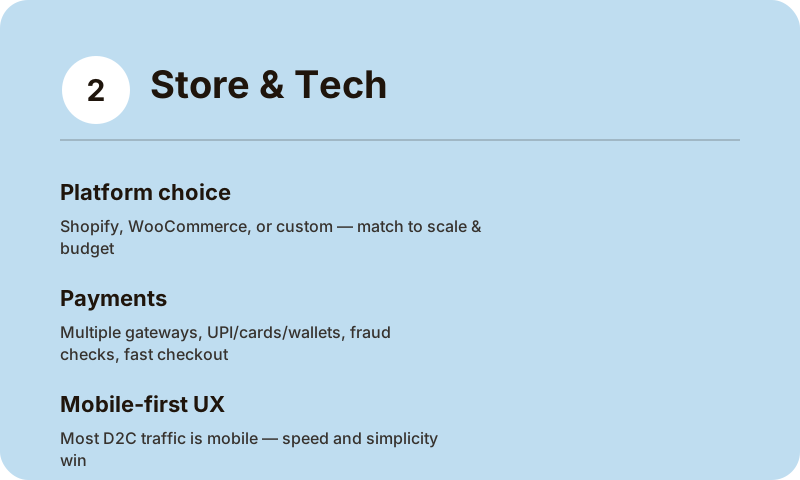
2. Store and Technology: Build the Thing Customers Actually Interact With
Choosing a platform
The platform decision gets more attention than it deserves relative to its actual impact on success, but it still matters. The real question isn’t “which platform is best” — it’s “which platform matches this business’s stage, budget, and technical resources.”
- Hosted platforms (Shopify and similar) trade some flexibility for speed, reliability, and low maintenance overhead. For most new D2C brands, this is the right starting point — the goal in year one is validating demand, not building infrastructure.
- Open-source, self-hosted options (WooCommerce and similar) offer more control and lower ongoing platform fees, at the cost of needing more hands-on technical maintenance.
- Custom-built storefronts make sense once a brand has outgrown the customization limits of off-the-shelf platforms — but building custom before there’s proven demand is one of the most common ways early-stage founders burn months of runway on the wrong problem.
The mistake to avoid isn’t picking the “wrong” platform — most reputable platforms can support a brand well past its first few million in revenue. The mistake is spending months perfecting the store before a single real customer has bought anything.
Payments
Checkout is the single highest-leverage page on the entire site, because it’s the last moment before revenue either happens or doesn’t. A few principles that consistently move the needle:
- Offer the payment methods your specific audience actually uses. This varies enormously by market — UPI and wallets dominate in some regions, cards in others, buy-now-pay-later options matter for higher price points in many Western markets.
- Minimize checkout friction. Every unnecessary form field, forced account creation, or extra click is a chance for a customer to abandon. Guest checkout should always be an option.
- Build in fraud and chargeback protection from day one. It’s much easier to configure this correctly at launch than to retrofit it after the first wave of fraudulent orders.
- Make shipping costs and delivery timelines visible early, not as a surprise at the final checkout step — this is one of the most commonly cited reasons for cart abandonment.
Mobile-first UX
For most D2C categories, the majority of traffic — and an increasing share of purchases — happens on mobile. A store that was designed on a desktop monitor and merely “made responsive” almost always has friction points that a mobile-native design wouldn’t: text too small, tap targets too close together, images that take too long to load on a mobile connection, checkout forms that fight with mobile keyboards.
Page speed deserves specific attention here. Every additional second of load time measurably increases bounce rate and decreases conversion — this isn’t a minor technical nicety, it’s a direct revenue lever, and it compounds with every paid click sent to a slow page.
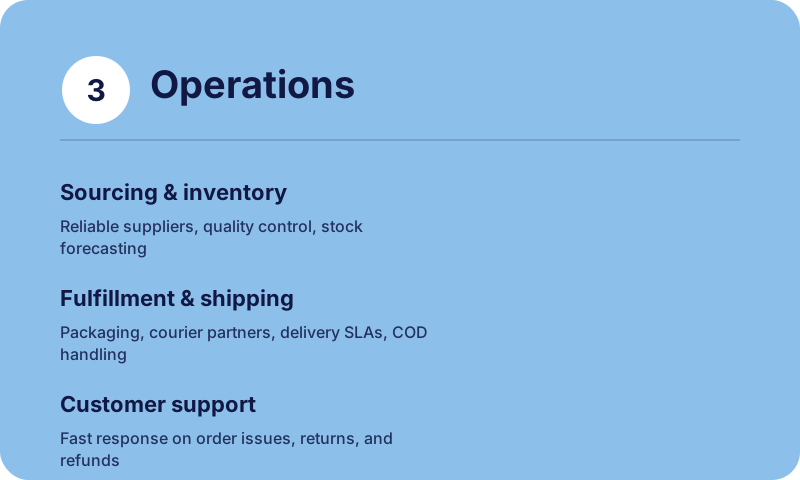
3. Operations: The Unglamorous Work That Determines Whether Customers Come Back
Sourcing and inventory
Getting the product itself right is the actual foundation everything else sits on top of, and it’s worth more scrutiny than founders often give it in the rush to launch:
- Supplier reliability matters more than unit cost in the early days. A slightly more expensive supplier who ships consistently and communicates clearly is worth far more than a marginally cheaper one who causes stockouts during your first big marketing push.
- Quality control processes should exist before scale, not after a wave of returns forces the issue. Spot-checking samples from every batch, especially early on, catches problems while they’re still small and cheap to fix.
- Inventory forecasting is a discipline, not a guess. Overstocking ties up cash that could be spent on growth; understocking means paying to acquire customers who then can’t buy the thing they clicked an ad for. Simple demand forecasting — even a spreadsheet tracking sell-through rate by SKU — beats no forecasting at all.
Fulfillment and shipping
Fulfillment is where brand promises are kept or broken, order by order. A customer doesn’t experience your brand values statement — they experience whether the box arrived on time, undamaged, and matching what they ordered.
- Packaging should protect the product and reinforce the brand simultaneously — this is one of the few touchpoints where a small additional cost per unit can generate outsized word-of-mouth and social sharing.
- Courier partner selection should account for reliability in the specific regions you serve, not just headline cost — a cheaper courier with a worse delivery success rate in your customers’ actual locations costs more in refunds, support tickets, and lost trust than it saves on the shipping line item.
- Cash-on-delivery, where relevant to the market, needs its own operational playbook — RTO (return-to-origin) rates can quietly destroy margins if not actively managed through verification steps and courier selection.
- Delivery SLAs should be set realistically and then met, not set optimistically and then missed. An honest “5-7 days” that’s hit every time builds more trust than an aspirational “2-3 days” that’s missed half the time.
Customer support
Support is not a cost center to be minimized — for an early-stage D2C brand, it’s often the highest-leverage retention and reputation tool available. A fast, empathetic response to an order problem can turn a potential negative review into a repeat customer and an advocate. A slow or defensive response does the opposite, and in the age of public reviews and social media, that response is often visible to far more people than just the original customer.
Practical essentials:
- Respond fast, especially to order-status and delivery questions, which are almost always time-sensitive to the customer.
- Make the returns and refund process genuinely easy, not just easy on paper — friction here erodes trust even among returning customers.
- Track recurring complaint themes; support tickets are some of the highest-quality product feedback a brand has access to, and they’re often ignored because they arrive one at a time instead of as a report.
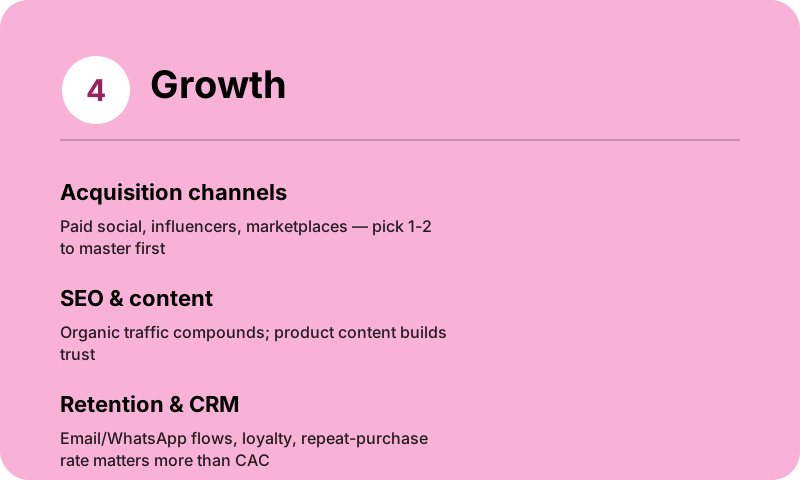
4. Growth: Getting Found, and Getting People Back
Acquisition channels
New brands often spread themselves across every channel at once — paid social, SEO, influencers, marketplaces, affiliate — and end up mediocre at all of them instead of genuinely effective at one or two. The stronger approach, especially with limited early budget, is choosing one or two channels that best match where the specific target customer already spends attention, and getting genuinely good at those before expanding.
- Paid social (particularly platforms like Meta and increasingly TikTok) works well for visually compelling, impulse-friendly products, but requires enough margin per order to absorb rising acquisition costs and enough creative testing volume to find winning ad angles.
- Influencer and creator partnerships can be highly efficient for brands with strong visual or lifestyle appeal, particularly through smaller, more engaged creators rather than only chasing the biggest names.
- Marketplaces (Amazon and category-specific equivalents) offer built-in demand and trust, at the cost of margin, customer data ownership, and brand control — a useful channel for volume, but rarely the foundation of a defensible D2C brand on its own.
- Organic search and content, covered next, compounds over time in a way paid channels don’t.
SEO and content
Paid acquisition is rented attention — the moment the budget stops, the traffic stops. Organic search traffic, by contrast, compounds: content and product pages built and optimized today keep generating traffic months and years later at close to zero marginal cost.
For a new ecommerce brand, this typically means:
- Well-structured, genuinely useful product pages — not just a product photo and a two-line description, but real detail that answers the questions a buyer actually has before purchasing.
- Content that addresses the specific problems the niche audience is searching for, which also does double duty as material for social and email marketing.
- Basic technical SEO hygiene — fast load times, clean URL structure, proper structured data for products — which is often overlooked in the rush to launch but has an outsized long-term payoff.
Retention and CRM
It’s dramatically cheaper to sell to an existing customer than to acquire a new one, yet a large share of new D2C brands invest almost entirely in acquisition and barely at all in retention. This is backwards, especially as acquisition costs across paid channels continue to climb industry-wide.
High-leverage retention tactics for an early-stage brand:
- Post-purchase email and messaging flows — order confirmation, shipping updates, a follow-up asking for a review, a well-timed reorder or replenishment reminder — largely automatable and high-impact once set up.
- A loyalty or rewards structure, even a simple one, gives repeat customers a reason to come back rather than comparison-shopping every time.
- Segmented communication based on purchase history, rather than blasting every customer with the same message, meaningfully improves both engagement and unsubscribe rates.
- Tracking repeat purchase rate as a core metric from day one — not just revenue or order count — because it’s often the clearest early signal of whether the brand has genuine product-market fit versus one-time novelty appeal.
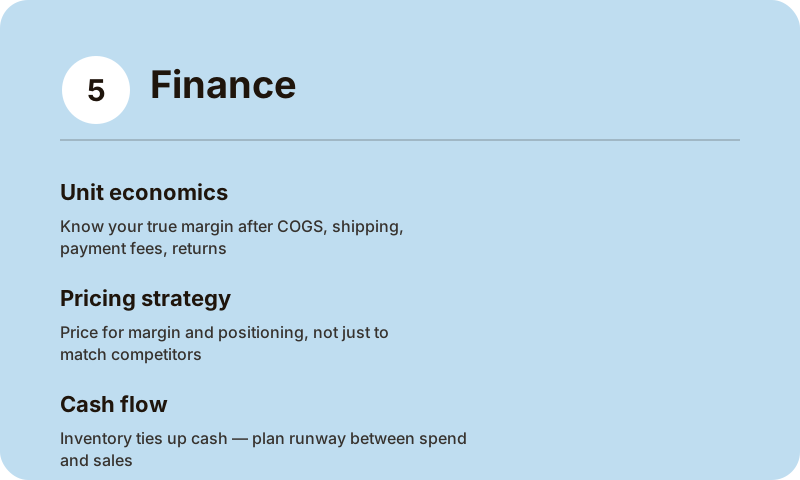
5. Finance: The Discipline That Determines Whether Growth Is Real
Unit economics
This is the area most likely to quietly sink an otherwise promising brand, because top-line revenue can look healthy while the business is losing money on every single order. True unit economics need to account for:
- Cost of goods sold (COGS)
- Payment processing fees
- Outbound shipping cost
- Return and RTO costs, including the cost of the returned or lost inventory itself
- A realistic, fully loaded customer acquisition cost (CAC), including all ad spend and any agency or tooling costs required to run it
- Packaging and fulfillment labor
Only after all of these are subtracted does a founder know the real contribution margin per order — and that number should be checked regularly, not calculated once at launch and forgotten. Margins erode quietly as ad costs rise, courier rates change, or return rates creep up, and a brand that isn’t tracking this closely can find itself scaling a loss without realizing it.
Pricing strategy
Pricing is one of the highest-leverage decisions in the entire business, and it’s frequently made reactively — by looking at what competitors charge — rather than strategically. A few considerations that matter more:
- Price needs to support the full unit economics above, with margin left over for marketing and profit, not just cover the product cost.
- Pricing communicates positioning. A price set too low can undermine perceived quality just as much as one set too high can price out the target customer.
- Bundle and volume pricing (multi-packs, subscriptions, “buy two get one”) can meaningfully improve average order value without needing to touch acquisition spend at all.
Cash flow
Profitable on paper and solvent in practice are two different things, especially for a physical-product business. Inventory ties up cash weeks or months before it converts back into revenue, and that gap — the time between paying a supplier and collecting from a customer — is where many otherwise-promising brands run into trouble.
Practical safeguards:
- Model cash flow explicitly, not just profit and loss — know how much runway exists between now and the next major inventory payment.
- Be conservative with reorder quantities until sell-through data is reliable enough to forecast confidently.
- Understand supplier payment terms and negotiate them where possible; even modest extended terms can meaningfully ease early cash pressure.
- Treat marketing spend increases cautiously until the cash conversion cycle is well understood — scaling ad spend faster than cash flow can support is a common and entirely avoidable way to run out of runway despite a genuinely working product.
Bringing It Together
None of these five pillars work in isolation. A brand with a sharp niche and beautiful positioning still fails if fulfillment is unreliable. A brand with flawless operations still fails if nobody can find the store or the unit economics don’t work. The brands that make it past the first two years are, almost without exception, the ones that treated all five as genuinely non-negotiable from the start — not perfect on day one, but deliberately built rather than left to chance.
If there’s one mental model worth carrying through all of this, it’s this: every one of these pillars is a form of trust-building with the customer — trust that the product will work, that the price is fair, that the delivery will arrive as promised, that a problem will be handled well if something goes wrong. Ecommerce, at its core, is a trust business wearing a technology costume. Get the trust right, at every one of these five layers, and the growth tends to follow.
